Skip to content
Save up to 80%
Nitroglycerin
Active ingredient: Nitroglycerin

Nitroglycerin

Quality products
24/7 Support
Fast delivery
Delivery from 4 days
Select pack Package Per unit Price

Free delivery on orders from $ 296.00, free express delivery from $ 444.00

Secure Payments
Track your order
Best price guarantee

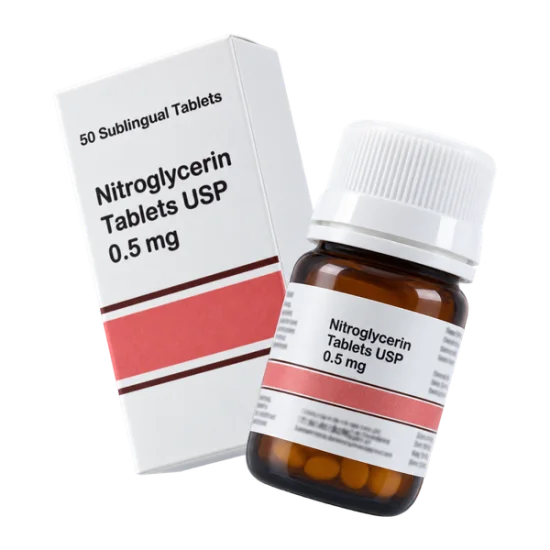
Nitroglycerin is a sublingual tablet used for prescribed treatment of acute angina pectoris in adults. It releases nitric oxide, relaxing blood vessels and reducing the heart’s oxygen demand. The regimen for the chosen strength should be confirmed with a healthcare professional before starting.

Overview

Nitroglycerin is a nitrate used to relieve episodes of angina pectoris, a symptom caused by an inadequate oxygen supply to the heart muscle. The regimen for the chosen strength should be confirmed with a healthcare professional before starting. The sublingual tablet is placed under the tongue for absorption through the oral tissues.

Dosage and administration

The regimen for the chosen strength is confirmed with a healthcare professional before starting. Some patients receive instructions for use at the onset of angina; others may receive instructions before predictable exertion. The schedule must match the individual prescription.

  • Use the tablet only by the sublingual route.
  • Sit down before administration.
  • Do not self-increase the dose.
  • Do not use another nitrate formulation as a substitute.
  • Keep track of the emergency instructions provided for the prescribed strength.
  • Seek urgent help for persistent or atypical chest pain.

A missed dose has different implications depending on whether nitroglycerin is being used for an acute episode or as part of a preventive regimen. A preventive dose should not automatically be doubled. The next step should follow the individual treatment plan.

Sublingual Administration Technique

  1. Stop the activity and sit or lie down.
  2. Place the prescribed tablet under the tongue.
  3. Allow it to dissolve rather than chewing it.
  4. Avoid swallowing it immediately.
  5. Follow the prescribed response plan if symptoms persist.
  6. Call 911 when symptoms are new, worsening, severe, or not improving as directed.

Chewing or swallowing a sublingual tablet changes the intended absorption route. A dry mouth can also make dissolution less comfortable, so keeping water available for ordinary use may help, although the tablet itself should remain under the tongue as prescribed.

Response Time and Emergency Escalation

Sublingual nitroglycerin is intended to act quickly, but the exact response varies with circulation, symptom cause, dose, and formulation. A person should use only the prescribed action sequence.

Emergency services are required when:

  • Chest pain is not improving within the time specified by the prescriber.
  • Pain returns quickly or becomes stronger.
  • Fainting, severe weakness, breathing difficulty, or confusion develops.
  • The symptoms differ from the person’s established angina.

Do not take extra doses simply because the first dose did not produce immediate relief. Repeated dosing can cause dangerous hypotension.

Formulation

The product is a sublingual tablet containing nitroglycerin. It is intended to dissolve under the tongue for absorption through the oral tissues. The regimen for the chosen strength should be confirmed with a healthcare professional before starting.

How it affects the body

Nitroglycerin is converted within the body to nitric oxide-related signalling molecules. These activate vascular smooth-muscle pathways, causing blood vessels to relax. The strongest practical effect is often venodilation, which reduces the amount of blood returning to the heart.

That returning blood volume is called preload. Lower preload reduces the stretching and workload of the heart before each contraction. The heart then needs less oxygen, which can ease pressure caused by an imbalance between myocardial oxygen supply and demand.

Effects on Cardiac Workload

Nitroglycerin can:

  • Relax veins and reduce venous return.
  • Lower cardiac filling pressure.
  • Reduce myocardial wall tension.
  • Decrease myocardial oxygen demand.
  • Relieve pressure associated with stable angina.

Nitroglycerin does not dissolve coronary plaques. It does not reliably open a completely blocked artery, and symptom relief does not exclude a heart attack.

Headache often reflects the same blood-vessel relaxation that produces the anti-anginal effect. A headache can occur even when the medicine is working.

Therapeutic indications

Nitroglycerin may be prescribed for:

  • Acute relief of predictable stable angina.
  • Prevention of angina before a known trigger, such as exertion, when specifically directed.
  • Short-term symptom control within a broader treatment plan for coronary artery disease.
  • Medical supervision during selected cardiovascular situations.

A dose that does not relieve chest discomfort does not prove that the pain is harmless. Angina can change over time, and symptoms may represent unstable angina or myocardial infarction.

Angina Warning Signs

Call 911 in Canada for chest pain that is:

  • New, severe, prolonged, or rapidly worsening.
  • Present at rest or occurring with less activity than usual.
  • Associated with shortness of breath, sweating, nausea, collapse, confusion, or marked weakness.
  • Not improving according to the prescribed emergency plan.
  • Different from the person’s usual angina pattern.

Do not drive yourself to emergency care. Nitroglycerin should never delay assessment for suspected acute coronary syndrome.

Common mistakes

Common Patient Mistakes

Standing immediately after dosing: This increases fall risk. Remain seated until the effect and symptoms are clear.

Swallowing the tablet: This defeats the intended sublingual route. Let it dissolve beneath the tongue.

Using expired or poorly stored medicine: Stability can be affected by heat and moisture. Keep the medicine in its designated container and use it within its stated expiry period.

Taking repeated doses without an emergency plan: Excess nitrate exposure can cause severe hypotension or syncope. Follow the prescribed escalation instructions.

Creating an unsupervised nitrate-free interval: The wrong timing can remove protection during a predictable angina period. Use only the schedule selected for the formulation.

Forgetting interaction history: A new prescription can change risk even when the nitroglycerin dose has remained stable. Review every new medicine with a pharmacist or prescriber.

The World Health Organization identifies cardiovascular disease as a major global cause of death, which is why persistent chest symptoms require urgent assessment rather than repeated self-treatment [4].

When not to use it

Nitroglycerin requires specific medical review in people with:

  • Current shock or severely low blood pressure.
  • Severe anaemia.
  • Raised intracranial pressure or recent intracranial bleeding.
  • Suspected right-sided myocardial infarction.
  • Severe dehydration or circulatory collapse.
  • Known hypersensitivity to nitrates.
  • A recent or current medicine interaction involving phosphodiesterase-5 inhibition.

Never combine nitrate therapy with phosphodiesterase-5 inhibitors without urgent professional direction. This interaction can produce a severe, potentially life-threatening fall in blood pressure.

When this is not for you

Nitroglycerin is not suitable for everyone. This medication is not for you if a prescriber has identified a contraindication such as severe hypotension, shock, or a dangerous interaction with another medicine.

The relevant medicine class includes treatments used for erectile dysfunction and some treatments used for pulmonary hypertension. A person should disclose the exact medicine and time of the last dose to emergency clinicians.

Do not stop betaxolol suddenly to make room for nitroglycerin. Abrupt withdrawal of some cardiovascular medicines can worsen cardiac symptoms.

Possible side effects

The most familiar adverse effects are headache, flushing, dizziness, weakness, palpitations, low blood pressure, and fainting. These effects arise from vasodilation and can be more pronounced after the first doses, after a dose increase, or when combined with other blood-pressure-lowering substances.

Common Vasodilator Effects

Headache may be throbbing and can occur soon after administration. Mild headache does not automatically mean an allergy. It may reflect the same nitrate action that lowers cardiac workload.

Other possible effects include:

  • Facial warmth or flushing.
  • Light-headedness.
  • Weakness or tiredness.
  • Nausea.
  • A faster heartbeat caused by reflex responses to lower blood pressure.
  • Dizziness when moving from sitting to standing.

Sitting or lying down can reduce the risk of injury. Driving, cycling, climbing ladders, or operating machinery is unsafe while dizzy.

Hypotension and Syncope

Hypotension means blood pressure has fallen too low for the person’s circulation. Syncope means a brief loss of consciousness caused by reduced blood flow to the brain. Both can occur after nitrate-induced vasodilation.

Urgent assessment is needed for:

  • Fainting or collapse.
  • A fall with head injury.
  • Persistent severe weakness.
  • Confusion or difficulty staying awake.
  • Breathing difficulty, facial swelling, or widespread hives.
  • Chest pain with a cold sweat, nausea, or marked shortness of breath.

The Canadian product-monograph framework identifies hypotension, syncope, and nitrate-related vasodilator reactions as clinically significant safety concerns [2].

A headache that is mild and short-lived can occur after nitroglycerin, but a sudden severe headache with weakness, confusion, vision changes, or collapse needs urgent assessment.

Comparison

Nitroglycerin and isosorbide dinitrate are nitrate medicines that reduce cardiac workload through vascular relaxation. Their formulations differ in onset, duration, dosing schedule, and suitability for acute relief or prevention.

Medicine or class Typical role Main limitation
Sublingual nitroglycerin Rapid relief of prescribed acute angina Short action and risk of headache or hypotension
Isosorbide dinitrate Preventive or scheduled nitrate therapy Formulation-specific dosing and tolerance
Non-nitrate antianginal drugs Longer-term symptom control Choice depends on heart rate, blood pressure, and comorbidities

Equivalent dosing cannot be assumed between nitroglycerin and isosorbide dinitrate. A prescriber selects treatment according to the diagnosis, blood pressure, heart rate, kidney and liver function, symptom pattern, and current medicines.

Nitroglycerin and Isosorbide Dinitrate

Isosorbide dinitrate may be used for angina pectoris, but it is not a direct replacement for a 0.5 mg sublingual nitroglycerin tablet. Changing between nitrate products without a new regimen can cause undertreatment, excessive vasodilation, or poorly timed nitrate exposure.

The European Medicines Agency describes nitrate therapy as formulation-dependent, with tolerance prevention and interaction screening forming part of safe use [3].

What doctors say

Nitroglycerin may be used in selected cardiac-care settings, but emergency clinicians first assess blood pressure, circulation, the electrocardiogram, right-sided heart involvement, and other causes of chest pain. Treatment decisions change when hypotension, shock, or right ventricular infarction is suspected.

A person with possible myocardial infarction should call emergency services rather than relying on repeated self-administration. The American Heart Association describes persistent or unexplained chest discomfort as an emergency symptom requiring immediate evaluation [1].

Common questions

Can people under 18 use Nitroglycerin?

Nitroglycerin should not be used by anyone under 18 unless a specialist has prescribed it for a defined cardiac condition. The evidence, diagnosis, dose, and emergency plan must be assessed individually. Health Canada’s 2023 safety information for nitrate products is directed toward formulation-specific prescribing rather than casual use in children. A child or teenager with chest pain, fainting, or breathing difficulty needs urgent medical assessment. The prescribing decision should follow the child’s cardiac evaluation.

How soon does the effect of sublingual Nitroglycerin become noticeable?

Sublingual Nitroglycerin is designed for rapid absorption, so an effect may become noticeable within minutes, though response varies with the cause of pain, circulation, and individual factors. The product’s prescribed instructions determine the permitted timing for reassessment and any repeat dose. The National Center for Biotechnology Information’s 2023 clinical pharmacology reference describes sublingual administration as faster than swallowed nitrate formulations [5]. Chest pain that persists or worsens requires 911 activation rather than repeated unsupervised dosing.

Does Nitroglycerin cause headaches?

Yes. Headache is a well-known effect of nitrate-induced blood-vessel relaxation. Health Canada’s 2023 product information notes that it may occur even when Nitroglycerin is relieving angina, but a severe or unusual headache with neurological symptoms requires urgent assessment. Sitting down, avoiding sudden standing, and following the prescribed dose can reduce fall risk; do not drive while dizzy.

What happens when Nitroglycerin is stopped, and does it need tapering?

A single sublingual dose is not normally tapered because it is used for an episode or a specific preventive event. Long-term nitrate schedules are different, especially when a person uses additional preventive formulations. Stopping a regular preventive regimen can allow angina to return, while abrupt changes may disrupt planned nitrate-free intervals. The Canadian Cardiovascular Society’s 2024 approach treats medication changes as part of an individualized angina plan, with the diagnosis and formulation guiding the decision.

Which diet, exercise, or habits help or hinder the result?

Nitroglycerin works within a wider plan for coronary disease, so gradual prescribed activity, smoking cessation, blood-pressure control, diabetes management, and a heart-healthy eating pattern can support symptom control. Heavy alcohol intake can worsen dizziness and low blood pressure after a nitrate dose. Exercise should follow the person’s cardiac rehabilitation or prescriber plan rather than being used to test whether chest pain is safe. The American Heart Association’s 2024 guidance recommends structured cardiovascular risk reduction alongside treatment for angina.

How long does a Nitroglycerin course last, and is long-term use acceptable?

There is no single course length for Nitroglycerin. Sublingual tablets may be used intermittently for acute episodes or before predictable exertion, while other nitrate formulations may be scheduled for prevention. Long-term nitrate therapy can be appropriate when the regimen includes monitoring and a suitable nitrate-free interval. Health Canada’s 2023 product information supports a treatment review when episodes recur, use increases, or benefit declines rather than self-escalation.

Do you offer anonymous delivery?

Your order will be securely packed and shipped within 24 hours. This is exactly what your package will look like (images of an actual item sent). It has the size and look of a regular private letter (24x11x0.7 cm) and its contents cannot be seen.

Storage and Handling Details

Sublingual nitroglycerin should remain in its designated container and be protected from conditions that can reduce stability, such as excessive heat or moisture. Keep it accessible to the person who may need it, not locked away in a place that cannot be reached during chest pain.

Tell every prescriber and pharmacist that you use nitrate therapy before a new medicine is started. This is especially important after treatment for erectile dysfunction, pulmonary hypertension, or high blood pressure.

Nitrate Tolerance and Treatment Scheduling

Continuous nitrate exposure can lead to tolerance, meaning the same dose may produce less vascular effect over time. Preventive nitrate regimens may therefore include a planned nitrate-free interval.

The timing depends on the formulation, dosing schedule, symptoms, and other cardiovascular medicines. Do not create a nitrate-free interval independently, because removing coverage at the wrong time may leave exertional angina untreated.

Customer Feedback on Nitroglycerin

4.3
Based on 4 reviews
Gary, 49 Kingston
Verified
Rating: 5 out of 5

I used the 0.5 mg sublingual tablets for predictable angina before activity as prescribed. The relief was clear, and having the tablets close by made ordinary outings feel more manageable.

Nov 3, 2026
David Z., 48 Windsor
Verified
Rating: 5 out of 5

I kept the bottle with me during walks and used a tablet when my usual chest pressure began. The response came quickly enough for me to settle down and continue following my cardiac plan.

Nov 9, 2026
Graham D., 30 Kelowna
Verified
Rating: 5 out of 5

Nitroglycerin helped when exertion brought on the familiar tightness. I liked that the sublingual tablet was straightforward to use and did not require swallowing water.

Oct 12, 2026
Liam, 26 Montreal
Verified
Rating: 2 out of 5

The tablets did not help the chest discomfort I was having, and the dizziness made me stop using them until the cause was reviewed. I needed medical assessment rather than taking more doses.

Oct 24, 2026

Sources

  1. American Heart Association (2024). Warning Signs of a Heart Attack.
  2. Health Canada (2023). Product Monograph — Nitroglycerin Sublingual Tablets
  3. European Medicines Agency (2022). Summary of Product Characteristics (SmPC) — Glyceryl Trinitrate
  4. World Health Organization (2025). Cardiovascular Diseases.
  5. National Center for Biotechnology Information (2023). Nitroglycerin — StatPearls.
Get our free app Shop faster and track your orders 4.0 · 306 reviews Install