I took Brahmi tablets according to the product directions each day during a busy study period. After several weeks, I found it easier to recall notes from earlier sessions and felt satisfied with the gradual benefit. It was not an immediate boost, but the change was useful.
Adults seeking plant-based support for memory, concentration, or everyday stress may consider Brahmi tablets containing the Ayurvedic herb associated with Bacopa monnieri. Brahmi is traditionally used as a medhya rasayana, or cognitive-support herb, while modern research focuses on bacosides and their possible effects on memory processes and stress response.
Overview
Brahmi is traditionally used as a medhya rasayana, or cognitive-support herb, while modern research focuses on bacosides and their possible effects on memory processes and stress response.
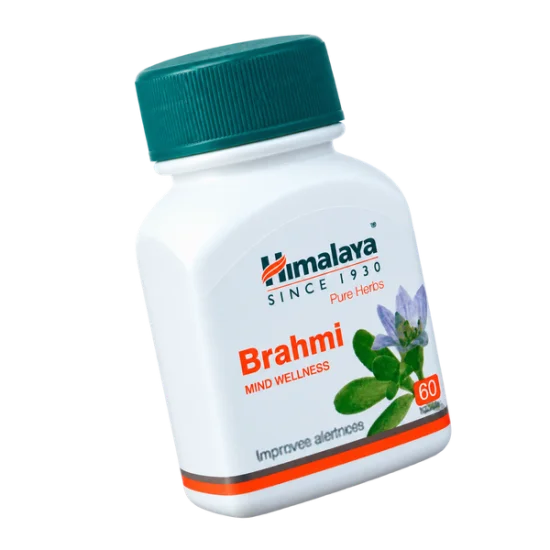
The product sold on this page is supplied as tablets in a bottle containing 60 tablets.
Dosage and administration
Practical administration points include:
- Take the tablets by mouth.
- Use the agreed schedule consistently.
- Swallow the tablet with water.
- Avoid doubling the next intake after a missed tablet.
- If a dose is missed, resume the usual schedule unless a prescriber gives different instructions.
- Do not combine several Brahmi preparations without checking the total intended intake.
Clinical research has often assessed Brahmi over several weeks rather than after one or two doses. A lack of an immediate sensation does not prove that the product has failed, while a strong adverse reaction is a reason to stop and seek specific medical advice. Keep the schedule consistent during any planned assessment. Record the target symptom and any unwanted effects. Discuss persistent problems with a doctor or pharmacist.
Formulation
Brahmi tablets contain the Ayurvedic herb associated with Bacopa monnieri. Modern research focuses on bacosides and their possible effects on memory processes and stress response. The product is supplied in a bottle containing 60 tablets; the exact amount per tablet and extract standardisation are not provided.
How it affects the body
Bacosides are the group of compounds most often studied in Bacopa monnieri extracts. Laboratory and clinical research suggests that these compounds may influence antioxidant activity, neuronal signalling, and pathways involved in synaptic communication. The evidence supports a possible role in memory formation and recall, though results depend on extract preparation, dose, study duration, and participant characteristics.[1]
Brahmi may help improve brain function through several connected mechanisms:
- Supporting communication between neurons.
- Influencing antioxidant defences in nervous tissue.
- Modulating pathways linked with synaptic plasticity.
- Supporting the process by which newly learned information becomes easier to recall.
- Helping regulate the physiological response to stress.
The word adaptogenic is used for herbs studied for their possible role in helping the body respond to physical or psychological stress. It does not mean that Brahmi produces an immediate calming effect in every person. Some people notice a gradual change in mental fatigue or stress tolerance, while others notice little difference.
Brahmi research has examined cholinergic signalling, serotonin-related pathways, antioxidant enzymes, and inflammatory mediators. These findings are biologically plausible, yet laboratory activity does not automatically establish a clinical treatment effect in people.
Therapeutic indications
Research on Bacopa monnieri has explored memory, anxiety, inflammation, oxidative stress, and vascular function. A systematic review published in Journal of Ethnopharmacology found that human studies have produced promising but variable results, with differences in extract standardisation and trial design limiting direct comparison.[2]
The best-supported research area is cognitive performance. Potential advantages include gradual memory support and a tablet format; limitations include variable evidence, gastrointestinal effects, and uncertain equivalence between extracts. Some controlled studies have reported improvements in delayed recall after sustained use, while attention and processing-speed findings have been less consistent. Brahmi may also reduce subjective stress or anxiety in selected participants, though it should not be presented as a treatment for an anxiety disorder.
Small studies have examined Bacopa monnieri in children with attention deficit hyperactivity disorder and related concentration difficulties. Some reported changes in attention, impulsivity, or behavioural scores after regular use, yet the studies were limited by small sample sizes, differing extracts, and short follow-up periods.
Brahmi may help support certain cognitive functions, but it has not replaced established ADHD assessment or treatment.
Health Canada’s approach to natural health products requires attention to product-specific directions and safety information rather than assuming that every preparation of the same herb has identical effects.[3]

Common mistakes
Several routine mistakes can make Brahmi difficult to evaluate:
- Taking it only on demanding study days.
- Combining tablets with tea, powder, oil, or another herbal formula.
- Expecting an immediate stimulant effect.
- Increasing the amount because memory has not changed after a few days.
- Continuing despite repeated diarrhoea, abdominal pain, dizziness, or a slow pulse.
- Using it to replace prescribed treatment for ADHD, anxiety, depression, epilepsy, or high blood pressure.
- Forgetting to mention it when a new medicine is prescribed.
- Giving the tablets to a child without checking age suitability and swallowing safety.
One overlooked detail is timing. If Brahmi causes stomach upset, taking it with food may improve comfort, although it does not solve a clinically significant adverse reaction. Another is sedation: if the first doses make you drowsy, avoid driving or operating machinery until the effect is clear.
When not to use it
- Known allergy to Brahmi or any tablet ingredient.
- Suspected intestinal obstruction or severe bowel narrowing.
- Markedly slow pulse or recurrent unexplained fainting.
- Pregnancy or breastfeeding without a clinician’s specific approval.
- Use of several medicines affecting the heart, thyroid, nervous system, or gastrointestinal tract.
- A child or teenager without professional guidance.
- New or worsening memory loss requiring diagnostic assessment.
When this is not for you
Brahmi is not for you if you need urgent assessment, plan to replace prescribed treatment, or have a condition that could make the supplement unsafe. Do not use it without professional guidance if you are pregnant or breastfeeding, are giving it to a child or teenager, have a very slow pulse or unexplained fainting, or have new or worsening memory loss. Ask a doctor or pharmacist before use if you take medicines affecting the heart, thyroid, nervous system, or gastrointestinal tract.
Possible side effects
Brahmi is often tolerated by adults when used appropriately, yet gastrointestinal effects can occur. Reported problems include nausea, abdominal discomfort, increased bowel movements, loose stools, and dry mouth. Sensitivity to a plant component may cause rash, itching, swelling, or other allergic symptoms.
Bacopa may influence gastrointestinal motility. People with a known gastrointestinal obstruction or a condition that causes significant bowel narrowing should avoid self-directed use. Caution is also sensible in people with a slow heart rate, fainting episodes, or medicines that affect cardiac conduction.
Potential interaction concerns include:
- Medicines that slow the heart rate.
- Thyroid medicines or treatment for thyroid disease.
- Sedating medicines.
- Medicines with anticholinergic effects.
- Treatments for neurological or psychiatric conditions.
- Other supplements that cause drowsiness or gastrointestinal stimulation.
Evidence for these interactions is not equally strong for every medicine. The risk assessment depends on the person’s diagnosis, treatment, age, and the composition of the tablet.
Comparison
Brahmi, Gotu Kola, Ashwagandha, and Ginkgo biloba belong to different botanical traditions and have different research profiles. They should not be treated as interchangeable simply because each is marketed for memory, stress, or concentration.
| Approach | Main research focus |
|---|---|
| Brahmi | Memory retention, recall, stress response, and antioxidant pathways |
| Gotu Kola | Traditional cognitive and circulation-related use, with variable clinical evidence |
| Ginkgo biloba | Vascular and cognitive research, especially in selected older populations |
Ashwagandha is more commonly studied for stress response, sleep, and perceived fatigue than for the delayed-recall outcomes associated with Brahmi. Ginkgo biloba research often focuses on circulation and cognitive symptoms in older adults, with results that vary by preparation and population.
The closest comparison should be based on the intended outcome. Someone seeking gradual memory support may consider Brahmi, while a person with significant anxiety, progressive memory loss, or diagnosed ADHD requires condition-specific assessment rather than simply choosing another herb.
What doctors say
In clinical practice, physicians usually set expectations around gradual change. Brahmi is more plausibly assessed through memory tasks, concentration demands, sleep quality, and perceived stress over time than through an immediate subjective effect.
A doctor would also ask what else could be affecting cognition. Poor sleep, alcohol, untreated sleep apnoea, depression, anxiety, thyroid disease, anaemia, and sedating medicines can all reduce concentration. Treating the underlying problem may matter more than adding a supplement.
One practical issue is formulation variability. Studies often use a characterised extract with a stated bacoside content, while a retail tablet may not provide the same standardisation. Results from a published trial therefore cannot be transferred directly to every Brahmi product.
WHO monographs on medicinal plants support careful attention to identity, preparation, traditional use, and safety rather than treating traditional history as proof of a clinical outcome.[4]
Comparison
Common questions
What happens when Brahmi is stopped, and is tapering necessary?
Brahmi is a non-prescription herbal supplement and does not have the same established withdrawal pattern as medicines such as benzodiazepines or antidepressants. Most people can stop it without a taper, although the perceived cognitive or stress-support effect may gradually disappear. A 2025 review indexed through PubMed found that clinical evidence for discontinuation effects remains limited. Health Canada advises reviewing continued natural health product use when symptoms return or new symptoms develop.[5]
Is Brahmi suitable during pregnancy or breastfeeding?
Routine use during pregnancy or breastfeeding is not recommended without specific clinical approval. Human safety data for Brahmi tablets during these periods are limited, and traditional use does not establish safety for a developing baby or breastfed infant. The EMA generally evaluates herbal preparations according to their evidence, preparation, and safety profile rather than relying on the plant name alone. An EMA guideline published in 2011 supports assessing the specific preparation and its quality. Avoid self-directed use during pregnancy or lactation.
Can older adults use Brahmi?
Older adults may use Brahmi only after considering pulse rate, bowel health, thyroid treatment, sedating medicines, and the reason for memory problems. New memory decline in later life deserves medical assessment because it can reflect medication effects, depression, sleep apnoea, nutritional deficiency, or neurological disease. A 2024 WHO approach to traditional and complementary medicine supports individualised risk assessment rather than treating age-related symptoms with an unreviewed supplement. Start no new cognitive product while overlooking a sudden or progressive change in memory.
Can people under 18 use Brahmi?
Children and adolescents should use Brahmi only when a qualified clinician has reviewed the product, formulation, and reason for use. Research in ADHD has involved selected preparations and small groups, so those findings do not establish that every Brahmi tablet is suitable for a young person. Health Canada’s 2023 natural health product framework places importance on age-specific directions and safety information. Do not use Brahmi as a replacement for an ADHD assessment or an established treatment plan.
How does Brahmi differ from the closest alternative by mechanism?
Brahmi is studied mainly for bacoside-related effects on memory processes, synaptic communication, and antioxidant pathways. Ginkgo biloba is studied more heavily in relation to vascular and cognitive mechanisms, while Ashwagandha research focuses more on stress response and sleep-related outcomes. A 2025 PubMed review found that herbal cognitive-support studies differ widely in extract standardisation and outcome measures. The most suitable option depends on the target symptom, current medicines, and medical history.
Can Brahmi cause diarrhoea or increased bowel movements?
Yes. Increased bowel movements, loose stools, abdominal discomfort, nausea, or dry mouth can occur with Brahmi, and gastrointestinal sensitivity may be more noticeable at the beginning. The EMA’s 2011 herbal-medicine safety principles support stopping a preparation when symptoms are persistent or severe rather than increasing the amount. Seek medical advice for severe diarrhoea, blood in the stool, dehydration, intense abdominal pain, or suspected obstruction.
Do you offer anonymous delivery?
Your order will be securely packed and shipped within 24 hours. This is exactly what your package will look like (images of an actual item sent). It has the size and look of a regular private letter (24x11x0.7 cm) and its contents cannot be seen.
Diversity of Preparations and Delivery Systems
Brahmi is available in several traditional and commercial forms, including Brahmi powder, Brahmi tea, Brahmi oil, Brahmi vati, Brahmi rasayana, and Brahmi ghrita. These preparations differ in extraction method, route of administration, concentration of plant constituents, and intended use.
| Preparation | Main practical distinction |
|---|---|
| Tablets or capsules | Oral products with a defined unit format, though extract strength varies |
| Powder or tea | Oral plant material with less predictable concentration |
| Oil or ghrita | Lipid-based preparations used in traditional practice and not equivalent to tablets |
Customer Feedback on Brahmi
I took Brahmi according to the product directions for my usual mental-wellness routine. After about a month, I felt less mentally scattered during reading and remembered small details more easily. The tablets were straightforward to include with breakfast.
I took Brahmi according to the product directions for concentration and noticed a modest improvement after several weeks, though it was slower than I expected. It also caused some extra bowel activity at first, so I reduced the routine after discussing it with a pharmacist.
I took Brahmi according to the product directions, and it fitted well into my daily routine. I did not feel stimulated, but after several weeks I found prolonged reading less tiring and was pleased with the result. Keeping the timing consistent made it easier to judge.
Sources
- PubMed (2012). The cognitive-enhancing effects of Bacopa monnieri: a systematic review of randomized, controlled human clinical trials.
- PubMed (2001). The chronic effects of an extract of Bacopa monnieri (Brahmi) on cognitive performance in healthy human subjects.
- Health Canada (2023). Natural Health Products: Product Licensing and Safety Information.
- World Health Organization (2009). WHO Monographs on Selected Medicinal Plants.
- European Medicines Agency (2011). Guideline on quality of herbal medicinal products/traditional herbal medicinal products