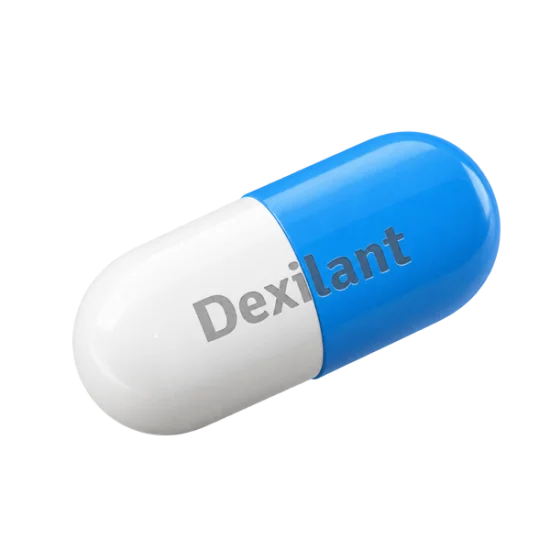
I used Dexilant for persistent heartburn and regurgitation. By the second week, I could sleep through the night without waking with acid in my throat. The improvement was clear enough that I stopped relying on chewable antacids during the day.
Dexlansoprazole, the active ingredient of Dexilant, is a proton pump inhibitor used for acid-related upper gastrointestinal conditions. It is prescribed for adults and selected paediatric patients with gastroesophageal reflux disease or erosive esophagitis, reducing stomach acid through dual delayed release.
Overview
Dexilant contains dexlansoprazole, a proton pump inhibitor that suppresses gastric acid production. Takeda Pharmaceuticals U.S.A., Inc. developed Dexilant as a modified-release capsule for acid-related conditions, especially gastroesophageal reflux disease (GERD), heartburn associated with GERD, and erosive esophagitis.
Dosage and administration
- Dose: The amount per administration is set individually for each person rather than being one fixed amount.
- Frequency: Take Dexilant according to the prescribed schedule.
- Timing: Take Dexilant orally with or without food.
- Duration: Use Dexilant for the clinician-selected duration, which depends on the indication, such as healing erosive esophagitis, controlling heartburn associated with GERD, or maintenance after healing.
- Route and form: Take Dexilant as an oral modified-release capsule and swallow it whole with water unless the prescriber gives specific instructions otherwise.
- Missed dose: Take a missed capsule when remembered unless the next scheduled dose is near. Do not double the dose.
Formulation
Dexilant contains dexlansoprazole, the active ingredient and a proton pump inhibitor that suppresses gastric acid production through dual delayed release.
How it affects the body
Dexlansoprazole belongs to the proton pump inhibitor class. After absorption, it reaches the acid-producing parietal cells in the stomach and inhibits the hydrogen-potassium ATPase, commonly called the gastric proton pump.
This pump is the final step in gastric acid secretion. Blocking it reduces the amount of hydrochloric acid released into the stomach, allowing inflamed oesophageal tissue to heal and lowering the chance that refluxed material will cause further irritation. The FDA prescribing information describes dexlansoprazole as an inhibitor of basal and stimulated gastric acid secretion.[2]
The effect differs from that of a simple neutralizing antacid. Antacids act locally and briefly, while a PPI changes the activity of the acid-secreting cells. Dexlansoprazole also differs from H2-receptor antagonists, which block histamine signalling involved in acid secretion. Both classes reduce acid, yet they act at different points in the pathway.
Therapeutic indications
Overview of Dexilant and Clinical Indications
The medication is not simply an antacid that neutralizes acid already present in the stomach. It reduces the production of new acid by acting on the acid-secreting proton pumps in stomach parietal cells. Health Canada recognizes dexlansoprazole-containing therapy for GERD-related indications, with the selected strength and treatment duration determined by the clinical presentation.[1]
Targeted Symptoms and Conditions
GERD occurs when stomach contents move back into the esophagus and cause symptoms such as:
- Burning behind the breastbone
- Acid regurgitation
- Sour taste in the mouth
- Upper abdominal discomfort
- Night-time reflux symptoms
- Difficulty sleeping because of heartburn
Erosive esophagitis is inflammation with visible injury to the esophageal lining. Stronger acid suppression may be used during healing, while a lower maintenance strength may be selected after healing in patients who continue to experience recurrent symptoms.
Dexilant can relieve heartburn by reducing the acid that irritates the esophagus. It does not repair every possible cause of chest or upper abdominal discomfort, so persistent chest pressure, vomiting blood, black stools, progressive swallowing difficulty, or unexplained weight loss require urgent medical assessment.
Stomach ulcers have different causes, including Helicobacter pylori infection and anti-inflammatory medicines. Acid suppression may form part of an ulcer treatment plan, but Dexilant should not be assumed to eradicate H. pylori or replace antibiotic treatment when infection is present.
Common mistakes
Several everyday mistakes can reduce benefit or increase risk:
- Chewing or crushing the modified-release granules
- Taking an extra capsule for breakthrough symptoms without a prescribed plan
- Stopping abruptly after prolonged daily use
- Ignoring black stools, vomiting blood, or progressive swallowing difficulty
- Treating recurrent symptoms as GERD without reassessing the diagnosis
- Failing to mention warfarin, methotrexate, rilpivirine, or digoxin
- Taking anti-inflammatory medicines regularly while assuming acid suppression removes all ulcer risk
- Continuing a higher healing strength after the healing phase without review
- Assuming symptom relief proves that no further investigation is needed
Late meals, alcohol, smoking, and lying down soon after eating can worsen reflux even when acid production is reduced. These factors do not mean the medicine has failed, but they may keep symptoms active through mechanical reflux.
When not to use it
Rilpivirine-containing treatment is a major interaction concern because reduced stomach acidity can lower rilpivirine absorption. Other medicines may also require review, including warfarin, methotrexate at high doses, digoxin, tacrolimus, clopidogrel, certain antifungals, and medicines whose absorption depends on gastric acidity.
When this is not for you
Dexilant is not suitable for everyone. NOT for you if you have had a serious reaction to a proton pump inhibitor, take rilpivirine, or have alarm symptoms requiring urgent investigation. The treatment requires specific review in the following situations:
- Previous serious allergy to dexlansoprazole, another PPI, or a capsule ingredient
- Current use of rilpivirine-containing medicines
- Previous severe reaction to acid-suppressing therapy
- Significant kidney disease or a history of drug-induced interstitial nephritis
- Low magnesium levels, especially with prolonged treatment
- Osteoporosis or a high fracture risk
- Symptoms suggesting gastrointestinal bleeding or a serious underlying disorder
- Pregnancy or breastfeeding, where the benefit-risk decision should be individualized
Possible side effects
Common adverse effects associated with dexlansoprazole include headache, diarrhoea, abdominal pain, nausea, vomiting, flatulence, and constipation. These effects are usually mild, though persistent diarrhoea can require medical assessment because acid suppression may increase susceptibility to certain intestinal infections.
Longer-term or repeated PPI use has been associated with low magnesium levels, vitamin B12 deficiency, bone fractures in higher-risk individuals, kidney inflammation, and fundic gland polyps. These outcomes are not inevitable, and the clinical relevance depends on duration, dose, age, medical history, and other medicines.
Seek urgent medical attention for facial swelling, breathing difficulty, widespread blistering rash, severe watery diarrhoea, reduced urine output, muscle spasms, marked weakness, or symptoms of a serious allergic or kidney reaction.
One detail patients often overlook is that persistent diarrhoea during acid-suppressing therapy should not automatically be treated with an over-the-counter anti-diarrhoeal product. Infection needs to be considered when diarrhoea is severe, prolonged, bloody, or accompanied by fever.
Another practical issue is rebound acid hypersecretion after abrupt discontinuation following prolonged use. Some people experience a temporary return of heartburn that feels stronger than before treatment. A planned reduction may be appropriate in selected cases, while patients receiving treatment for erosive disease should not stop without a clear clinical plan.

Comparison
Comparison with Related Acid-Suppressing Options
Dexilant can be compared with other acid-suppressing categories by active substance and mechanism rather than by brand.
| Treatment category | Main action | Practical distinction |
|---|---|---|
| Dexlansoprazole | Blocks the gastric proton pump with dual delayed release | Flexible food timing and two release phases |
| Other PPIs | Block the gastric proton pump | Many require more structured timing around meals |
| H2-receptor antagonists | Block histamine-driven acid secretion | Often provide shorter acid suppression and may be less suitable for healing erosive injury |
A physician may favour a proton pump inhibitor when the goal is healing erosive esophagitis or controlling frequent acid exposure. An H2-receptor antagonist may suit selected patients with intermittent symptoms, though tolerance can reduce its effect with repeated use.
Dexilant’s dual delayed-release system is a formulation difference, not a guarantee that it will outperform every other PPI for every patient. Some people respond well to a conventional PPI, while others obtain better symptom control with a formulation that provides a later second release.
What doctors say
In clinical practice, physicians generally assess three points before selecting a PPI: the likely cause of symptoms, the need for healing, and the shortest duration that maintains control.
A doctor may recommend investigation rather than indefinite acid suppression when symptoms are new, progressive, or accompanied by swallowing difficulty, anaemia, vomiting, bleeding, or unexplained weight loss. These features can signal a condition that requires endoscopy or another diagnostic test.
The best response is not always produced by increasing the strength. A patient may have non-acid reflux, delayed stomach emptying, medication-related irritation, or functional heartburn. Increasing acid suppression in those situations may add adverse effects without correcting the cause.
Physicians also reassess long-term treatment. Health Canada's 2023 product monograph provides product-specific dosing, interaction, and risk information, while NICE guideline CG184 addresses reflux assessment and treatment.[3] The treatment plan may change after healing, after an endoscopy, or after symptoms have remained controlled for an appropriate period.
Comparison
Common questions
Can people under 18 use Dexilant?
Dexilant may be prescribed for certain paediatric patients, with the approved age range and dose depending on the indication and formulation. The FDA paediatric prescribing information from 2022 supports age-specific use for selected GERD-related conditions rather than unrestricted use in every child.[2] Children with difficulty swallowing, poor weight gain, recurrent vomiting, or persistent abdominal pain require assessment of the underlying cause before treatment is selected.
Can Dexilant cause diarrhoea?
Diarrhoea is a recognized adverse effect of dexlansoprazole and may be mild and temporary. The FDA safety information from 2022 also warns that severe or persistent diarrhoea during PPI treatment can indicate an intestinal infection requiring assessment. Bloody stools, fever, dehydration, or diarrhoea that continues after stopping the medicine need prompt medical attention.
Which condition rules Dexilant out?
A previous serious allergic reaction to dexlansoprazole, another proton pump inhibitor, or an ingredient in the capsule rules out further use unless a specialist determines otherwise. Rilpivirine-containing treatment is also a specific contraindication because increased gastric pH can reduce rilpivirine exposure. The 2023 Health Canada product monograph identifies these precautions within the approved safety information.
How does Dexilant differ from omeprazole?
Both dexlansoprazole and omeprazole are proton pump inhibitors that block the gastric proton pump. Dexilant uses two delayed-release phases, while standard omeprazole formulations commonly rely on a single delayed-release phase and may require more careful timing around meals. The 2022 FDA prescribing information for omeprazole describes delayed-release formulations and dosing instructions; treatment choice still depends on indication, response, interactions, and patient-specific factors rather than assuming one PPI suits everyone.[4]
What should I do after missing a Dexilant dose?
Take the missed capsule when remembered unless the next scheduled dose is close. In that situation, skip the missed dose and return to the normal schedule rather than taking two capsules together. The 2022 FDA prescribing information advises against doubling doses after a missed dose because it increases exposure without providing reliable additional symptom control.
Do you offer anonymous delivery?
Your order will be securely packed and shipped within 24 hours. This is exactly what your package will look like (images of an actual item sent). It has the size and look of a regular private letter (24x11x0.7 cm) and its contents cannot be seen.
Dual Delayed-Release Formulation Technology
Dexilant capsules use a dual delayed-release design. The capsule contains dexlansoprazole in two types of enteric-coated granules that release the active ingredient at separate points in the digestive tract.
The first release provides an earlier phase of acid suppression. The second release occurs later, extending suppression across a longer part of the day than a single immediate-release pulse. This design is one reason Dexilant can be taken without requiring the same meal-timing routine used with some other proton pump inhibitors.
The delayed-release system depends on the physical integrity of the granules. Crushing, chewing, or dissolving the granules can interfere with the intended release pattern. The capsule itself may be opened in some situations, but the granules must remain intact and should be swallowed as directed by the prescriber.
The dual-release design does not mean that one capsule provides unlimited acid control. Symptoms may still occur with large meals, alcohol, tobacco exposure, late-night eating, or reflux caused by a weak lower oesophageal sphincter. Medication reduces acid injury, but it does not mechanically prevent stomach contents from moving upward.
Customer Feedback on Dexilant
Dexilant reduced the burning after meals, but the benefit took several days rather than appearing immediately. I noticed mild loose stools during the first week, which settled without stopping treatment. It helped, although I still had symptoms after very late meals.
I tried Dexilant for several weeks and did not get enough relief from the upper abdominal discomfort. I also developed frequent diarrhoea and stopped taking it after discussing the problem with my doctor. A different explanation for the symptoms was considered afterward.
The medication made a noticeable difference to night-time reflux. I was able to sleep flat again after the symptoms had been disturbing me for months. Taking one capsule as scheduled was easier than planning every dose around meals.
Dexilant controlled the sour taste and burning that had followed most dinners. The change was gradual, but by the end of the first couple of weeks I felt comfortable eating normally again. I was satisfied with the symptom relief.
Sources
- Health Canada (2023). Product Monograph: Dexilant (dexlansoprazole delayed-release capsules).
- U.S. Food and Drug Administration (2022). Dexilant (dexlansoprazole) Delayed-Release Capsules Prescribing Information.
- NICE (2019). Gastro-oesophageal reflux disease and dyspepsia in adults: investigation and management (CG184).
- U.S. Food and Drug Administration (2022). Prilosec (omeprazole) delayed-release capsules prescribing information.