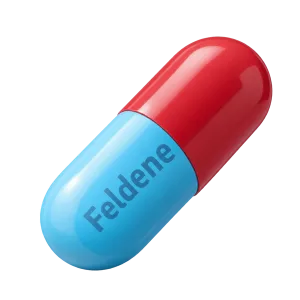
I used Feldene capsules at the prescribed dose for several days for inflammatory knee pain and noticed that movement became easier. I could manage normal work tasks with less stiffness, and the daily routine was straightforward.
Piroxicam, the active ingredient of Feldene, is a non-steroidal anti-inflammatory drug used for inflammatory pain and stiffness in conditions such as osteoarthritis and rheumatoid arthritis. Feldene capsules are intended for adults who need anti-inflammatory pain relief, with treatment duration and dosing agreed with a doctor or pharmacist. Piroxicam reduces prostaglandin production, easing inflammation, swelling, and joint discomfort.
Overview
Feldene contains piroxicam, a non-steroidal anti-inflammatory drug, also called an NSAID. It provides analgesic and anti-inflammatory effects by reducing the chemical signals that contribute to pain, warmth, swelling, and restricted movement. Piroxicam is used in inflammatory musculoskeletal conditions, including osteoarthritis and rheumatoid arthritis, when an NSAID is clinically appropriate.
Dosage and administration
Feldene is supplied in capsule form for oral administration. The capsule should be swallowed rather than opened, crushed, or chewed unless a prescriber or pharmacist has given a specific instruction for that product.
The correct amount and frequency depend on the condition being treated, the patient’s age, kidney and liver function, previous ulcer history, and other medicines. The dosing plan is agreed with a doctor or pharmacist.
Do not combine different Feldene presentations or add another systemic NSAID independently. Combining NSAIDs does not reliably improve pain control and can increase gastrointestinal bleeding, kidney injury, and cardiovascular risk.
Oral administration
Capsules are taken by mouth at the schedule selected for the individual patient. A consistent daily routine can reduce missed doses. Choosing the same general time each day may also make it easier to recognise whether pain relief is improving.
Injectable presentations
Injectable piroxicam presentations are separate clinical products and are not the capsule form described here. Intramuscular administration requires a healthcare professional and should not be substituted for oral capsules without a prescribing decision.
The amount of Feldene and how often it is taken depend on the purpose of treatment and are agreed with a doctor or pharmacist. Use the prescribed schedule rather than adjusting the dose according to the severity of pain on a single day.
Practical administration points include:
- Swallow the capsule with water.
- Take it with food if it irritates the stomach.
- Avoid taking more than the prescribed amount.
- Use the shortest treatment duration that provides suitable control.
- Do not combine it with another systemic NSAID unless specifically directed.
- If a dose is missed, take it when remembered unless the next scheduled dose is close.
- Do not double the next dose to compensate for a missed capsule.
- Seek urgent medical care for vomiting blood, black stools, severe chest pain, sudden weakness, or difficulty breathing.
Treatment may require review if pain remains uncontrolled, if mobility worsens, or if new symptoms appear. Persistent pain does not always mean that more piroxicam is appropriate; it may indicate a different diagnosis, a complication, or the need for another treatment approach.
A common practical mistake is taking Feldene only on the worst pain days while also using another NSAID on the remaining days. This can create unpredictable exposure and increase toxicity without producing stable inflammation control.

Formulation
The product form covered here is capsules for oral use. Piroxicam has a longer duration of action than several shorter-acting NSAIDs, so the prescribing clinician weighs convenience against its gastrointestinal, renal, and cardiovascular risks. Health Canada and the European Medicines Agency recognise the need for careful patient selection with systemic NSAIDs [1].
Piroxicam is not a simple painkiller that only masks sensation.
How it affects the body
Its anti-inflammatory activity targets cyclooxygenase pathways involved in prostaglandin formation. Pain may improve before joint stiffness or swelling has fully settled.
Piroxicam inhibits cyclooxygenase enzymes, commonly described as COX enzymes. These enzymes help convert arachidonic acid into prostaglandins, which participate in pain signalling, inflammation, and fever. Lower prostaglandin production can reduce tenderness, swelling, and stiffness.
The same prostaglandins also support the stomach lining, kidney blood flow, and some cardiovascular functions. This explains why the anti-inflammatory action can be useful while still creating risks in the digestive system, kidneys, and circulation.
Piroxicam is not a corticosteroid and does not suppress the immune system in the same way as steroid treatment. It is also different from opioid analgesics because it does not act through opioid receptors or produce opioid-type respiratory depression.
Its relatively long action can help patients avoid several doses during the day, yet the longer exposure also means adverse effects may persist after a dose is stopped. The World Health Organization identifies NSAID selection as a balance between pain control, inflammation, patient risk factors, and the lowest suitable exposure [2].
Therapeutic indications
Feldene is used in adults for inflammatory pain and stiffness associated with musculoskeletal conditions such as osteoarthritis and rheumatoid arthritis, when treatment with an NSAID is clinically appropriate. Piroxicam helps reduce inflammation, swelling, and joint discomfort.
Common mistakes
Several avoidable patterns can reduce benefit or increase harm:
- Taking Feldene with ibuprofen or naproxen.
- Using aspirin for pain without reporting it.
- Doubling a missed dose.
- Continuing treatment despite black stools or vomiting blood.
- Ignoring new ankle swelling or reduced urine output.
- Taking leftover capsules for a new pain problem.
- Assuming food removes the risk of an ulcer.
- Combining the medicine with heavy alcohol use.
- Failing to mention warfarin, corticosteroids, lithium, methotrexate, or blood-pressure treatment.
- Stopping prescribed low-dose aspirin without a clinician’s direction.
A missed dose is handled by taking it when remembered unless the next dose is near. Two doses should not be taken together.
When this is not for you
Feldene is not suitable for everyone. This medication is not for you if you have had an allergic reaction, asthma attack, severe wheezing, or swelling after piroxicam, aspirin, or another NSAID.
Possible side effects
Digestive symptoms are among the more common problems associated with systemic NSAIDs. These may include indigestion, nausea, abdominal discomfort, diarrhoea, constipation, or heartburn. Taking Feldene with food may reduce irritation for some people, but food does not prevent ulceration or gastrointestinal bleeding.
More serious reactions include:
- Stomach or intestinal ulceration.
- Gastrointestinal bleeding or perforation.
- Black, tarry stools or vomiting blood.
- Kidney impairment, fluid retention, or reduced urine output.
- Increased blood pressure or worsening heart failure.
- Serious skin reactions.
- Liver injury.
- Allergic reactions such as facial swelling, wheezing, or difficulty breathing.
- Cardiovascular events, including heart attack or stroke.
The risk of ulceration and bleeding rises with older age, previous peptic ulcer disease, higher exposure, longer treatment, alcohol excess, corticosteroids, anticoagulants, antiplatelet medicines, and selective serotonin reuptake inhibitors. The FDA prescribing information for piroxicam describes these gastrointestinal and cardiovascular warnings in detail [3].
One detail patients often miss: a stomach ulcer can develop without dramatic pain. Black stools, unusual tiredness, dizziness, or fainting may reflect blood loss and need urgent assessment.
Another practical point is ankle swelling. New swelling can reflect fluid retention, kidney effects, heart problems, or another condition; it should not simply be treated by taking less water or adding a diuretic independently.
Comparison
Piroxicam, ibuprofen, naproxen, and celecoxib belong to related therapeutic groups, though their duration, selectivity, and risk profiles differ. The choice depends on the inflammatory condition, ulcer risk, kidney function, cardiovascular history, age, and other medicines.
| Option | Main pharmacological feature | Typical clinical distinction |
|---|---|---|
| Piroxicam | Longer-acting non-selective NSAID | Useful when sustained anti-inflammatory activity is selected, with careful risk assessment |
| Ibuprofen or naproxen | Non-selective NSAIDs with different duration profiles | Often selected when a shorter or intermediate dosing pattern is preferred |
| Celecoxib | More COX-2 selective NSAID | May be considered in selected patients with gastrointestinal risk factors, while cardiovascular assessment remains necessary |
The comparison is not a recommendation to change treatment independently. A shorter-acting NSAID may be easier to stop quickly if an adverse effect occurs, whereas a longer-acting option may offer a simpler routine. COX-2 selectivity may reduce some stomach-related effects in selected patients but does not remove kidney, blood-pressure, or cardiovascular concerns.
Muscle relaxants address muscle spasm rather than prostaglandin-driven joint inflammation. They are not automatic substitutes for Feldene and can cause sedation or impaired coordination depending on the active substance.
What doctors say
A prescriber may ask about previous ulcers, indigestion, blood pressure, ankle swelling, kidney disease, anticoagulants, corticosteroids, and alcohol intake. These questions are directly linked to the known safety profile of systemic NSAIDs.
Patients sometimes expect an immediate change in joint function. Pain relief may begin before stiffness and swelling improve, and chronic inflammatory disease may require broader treatment than an NSAID alone. Persistent morning stiffness, progressive swelling, fever, or loss of function warrants reassessment.
Piroxicam should not be used as a way to keep exercising through unexplained severe pain. Reduced pain can make overuse easier, while the underlying joint or soft-tissue problem continues.
Comparison
Common questions
How does Feldene differ from shorter-acting NSAIDs?
Feldene contains piroxicam, a longer-acting non-selective NSAID, while ibuprofen and some other options have shorter durations and may require a different dosing pattern. The longer action can simplify administration, though exposure may continue for longer after an unwanted reaction. Health Canada guidance from 2024 supports individual risk assessment when selecting systemic NSAIDs. The distinction is pharmacological rather than a reason to switch treatment without clinical advice. A pharmacist can help review the choice.
Can Feldene cause stomach problems?
Yes. Piroxicam can cause indigestion, abdominal pain, ulceration, and gastrointestinal bleeding. The risk is higher with previous ulcers, older age, corticosteroids, anticoagulants, antiplatelet medicines, and prolonged treatment. The FDA piroxicam label from 2020 warns that serious gastrointestinal bleeding can occur without early severe pain. Black stools or vomiting blood require urgent medical attention.
What should I do if Feldene does not relieve the pain?
Do not increase the dose or add another NSAID independently. Persistent pain may mean that the condition needs reassessment, that inflammation is not the only cause, or that another treatment is required. The European Medicines Agency product information from 2023 supports using piroxicam only when its expected benefit justifies its risks. A doctor or pharmacist can review the diagnosis, treatment duration, interactions, and alternative approaches.
What should I do after missing a Feldene dose?
Take the missed capsule when remembered unless the next scheduled dose is close. If the next dose is near, skip the missed dose and return to the agreed schedule. Do not take two capsules together to compensate. WHO medication-safety guidance from 2017 supports avoiding dose doubling when the missed medicine could increase toxicity.
Can Feldene be taken with food?
Yes, taking Feldene with food may reduce stomach irritation for some patients. Food does not eliminate the risks of ulceration, bleeding, kidney injury, or cardiovascular effects. Avoid heavy alcohol use because it can add to gastrointestinal harm. Health Canada patient information from 2024 emphasises attention to NSAID-related stomach and bleeding symptoms.
Do you offer anonymous delivery?
Your order will be securely packed and shipped within 24 hours. This is exactly what your package will look like (images of an actual item sent). It has the size and look of a regular private letter (24x11x0.7 cm) and its contents cannot be seen.
Customer Feedback on Feldene
I took Feldene at the prescribed dose for several days, and it reduced the pain in my hands, although the improvement was slower than I expected. I had mild indigestion at first, so taking it with a meal made the capsules easier to tolerate.
I used the capsules at the prescribed dose for several days during a flare of joint inflammation and found that walking and climbing stairs became less uncomfortable. The relief was practical rather than dramatic, but it helped me get through ordinary activities.
I took Feldene at the prescribed dose for several days, and it helped with persistent stiffness in my hips and made mornings more manageable. I kept to the agreed schedule and avoided adding other anti-inflammatory painkillers.
Sources
- Health Canada (2024). Product Monograph: Piroxicam — Non-Steroidal Anti-Inflammatory Drug Information.
- World Health Organization (2023). WHO Model List of Essential Medicines: Anti-inflammatory and Analgesic Medicines.
- U.S. Food and Drug Administration (2020). Feldene (Piroxicam) Capsules Prescribing Information.