Skip to content
Save up to 80%
Chloramphenicol
Active ingredient: Chloramphenicol

Chloramphenicol

Quality products
24/7 Support
Fast delivery
Delivery from 4 days
Select pack Package Per unit Price

Free delivery on orders from $ 296.00, free express delivery from $ 444.00

Secure Payments
Track your order
Best price guarantee

Chloramphenicol is supplied as oral capsules swallowed with water and used for selected serious bacterial infections when a clinician considers it appropriate. It stops susceptible bacteria from making essential proteins, but its potential for serious blood-related toxicity limits routine use.

Overview

Chloramphenicol is a broad-spectrum antibiotic medicine that acts against several Gram-positive and Gram-negative bacteria. Oral capsules deliver the active substance systemically, so treatment affects the whole body rather than only a surface area.

Dosage and administration

Administration and Dose Planning

How much to use and how often depends on the purpose of use and is agreed with a doctor or pharmacist. The correct regimen depends on the infection, bacterial susceptibility, kidney and liver function, age, body weight, and the formulation supplied.

Typical clinical planning includes:

  • Swallowing the capsule with water.
  • Taking each dose at the prescribed interval.
  • Completing the prescribed course unless a clinician stops treatment because of toxicity or a change in diagnosis.
  • Avoiding unsupervised dose increases when symptoms remain.
  • Taking a missed dose when remembered unless the next scheduled dose is near.
  • Skipping the missed dose when the next dose is due soon.
  • Never doubling the next dose to compensate.

The timing may be adjusted around food if stomach upset occurs, but the regimen should remain consistent. Some products have formulation-specific instructions, so the dispensing pharmacist should confirm whether food changes absorption for the exact capsule supplied.

If vomiting occurs soon after a dose, do not automatically repeat it. The right action depends on how much time passed and whether the capsule may already have been absorbed.

One overlooked issue is treatment duration. Chloramphenicol should not be continued merely because a few capsules remain. The planned course is linked to the infection and the patient’s response, not to finishing an arbitrary supply.

Formulation

Pharmaceutical Presentations and Naming

Chloramphenicol is the active pharmaceutical ingredient. It has been formulated in different countries as oral preparations, injectable products, eye drops, and eye ointments. Commercial names and concentrations vary by jurisdiction, so a product designed for the eye should not be assumed to match an oral capsule.

The following distinctions are clinically useful:

  • Oral capsules are intended for systemic treatment.
  • Chloramphenicol eye drops are intended for direct ocular application.
  • Chloramphenicol eye ointment is intended for the ocular surface.
  • Injectable forms are used in supervised clinical settings when oral treatment is unsuitable.

How much to use and how often depends on the purpose of use and is agreed with a doctor or pharmacist.

How it affects the body

Mechanism of Antimicrobial Action

Chloramphenicol enters susceptible bacterial cells and binds reversibly to the 50S subunit of the bacterial ribosome. It blocks peptidyl transferase activity, the step that joins amino acids into new proteins. Without protein production, bacterial growth and multiplication slow or stop.

The usual result is bacteriostatic action. “Bacteriostatic” means that bacterial reproduction is inhibited while the immune system helps clear the remaining organisms. Against certain highly sensitive bacteria, including some strains of Haemophilus influenzae, chloramphenicol may produce bactericidal activity.

The mechanism differs from that of tetracyclines, which bind to the 30S ribosomal subunit, and from beta-lactam antibiotics, which interfere with bacterial cell-wall construction.

Treatment approach Main target Typical clinical role
Chloramphenicol 50S ribosomal subunit Selected serious bacterial infections
Tetracycline-class antibiotic 30S ribosomal subunit Susceptible bacterial infections with a different resistance profile
Beta-lactam antibiotic Cell-wall synthesis Many susceptible respiratory, skin, urinary, and systemic infections

Resistance may arise through bacterial enzymes that inactivate chloramphenicol, reduced drug entry, or changes in the bacterial ribosome. Laboratory susceptibility testing can therefore influence treatment selection.

EMA pharmacology materials describe the reversible ribosomal action and the importance of restricting systemic use because of potentially severe haematological toxicity [2].

Therapeutic indications

Pharmacological Profile and Indications of Chloramphenicol

The drug may be considered for serious bacterial infections when other antibiotics are unsuitable because of resistance, intolerance, allergy, or limited access to alternatives. Historical clinical use has included severe infections such as meningitis, typhoid fever, rickettsial disease, and selected cases of tetracycline-resistant cholera. These applications require a clear diagnosis and close medical monitoring.

It is not a routine treatment for a cold, influenza, or another viral illness. Antibiotics do not remove viral infections.

WHO places chloramphenicol among medicines with important clinical uses but significant safety restrictions [1]. The risk–benefit balance is assessed more carefully than it is for many commonly used antibiotics.

Do not self-start chloramphenicol for diarrhoea, sore throat, cough, or fever without a confirmed bacterial indication. An unnecessary course can expose you to toxicity without treating the cause.

Common mistakes

Common Patient Mistakes

Several mistakes can reduce treatment success or increase risk:

  • Using capsules for a viral illness.
  • Stopping treatment after the first improvement without medical advice.
  • Taking doses at irregular times.
  • Doubling a dose after forgetting one.
  • Sharing capsules with a family member.
  • Saving leftover capsules for a future infection.
  • Ignoring bruising, fever, mouth ulcers, or marked weakness.
  • Assuming an eye preparation and oral capsule have the same instructions.
  • Taking other medicines without reporting them to the prescriber.
  • Crushing or opening the capsule when the formulation should remain intact.

Another common error is judging treatment only by temperature. A lower fever does not prove that the infection has cleared, and a persistent fever does not automatically justify a higher dose.

People sometimes continue the drug because symptoms are improving slowly. With chloramphenicol, prolonged unsupervised use creates avoidable exposure to blood toxicity without guaranteeing better bacterial clearance.

When not to use it

Contraindications and Important Interactions

  • A previous serious reaction to chloramphenicol.
  • A history of chloramphenicol-related aplastic anaemia or severe bone-marrow suppression.
  • Significant pre-existing blood-cell abnormalities.
  • Severe liver impairment without specialist dose planning.
  • Use for a minor infection that has safer, suitable alternatives.
  • Use in a newborn or young infant without specialist supervision.
  • Pregnancy or breastfeeding without an explicit medical assessment.

Additional caution applies to people receiving chemotherapy, radiotherapy, anticonvulsants, anticoagulants, or medicines that suppress bone-marrow function. Chloramphenicol can alter the metabolism of some medicines by inhibiting hepatic enzymes, which may increase exposure to drugs such as warfarin, phenytoin, phenobarbital, or certain sulfonylureas.

Health Canada safety information emphasizes the need to assess blood disorders and medication interactions before systemic exposure to chloramphenicol [3].

When this is not for you

Chloramphenicol is not suitable for everyone. The treatment is not for you if any of the following applies unless a specialist has made a documented decision that the benefit outweighs the risk:

Possible side effects

Side Effects and Tolerability

Oral chloramphenicol can cause nausea, vomiting, diarrhoea, abdominal discomfort, headache, or irritation of the mouth and throat. These effects may be temporary, yet persistent or worsening symptoms need medical review.

The major concern is blood toxicity. Chloramphenicol has been associated with dose-related reversible bone-marrow suppression and rare, unpredictable aplastic anaemia. Aplastic anaemia is a serious failure of the bone marrow to produce enough red cells, white cells, and platelets.

Possible warning signs include:

  • Unusual tiredness, pale skin, or breathlessness.
  • Fever, chills, or repeated infections.
  • Easy bruising or bleeding.
  • Nosebleeds that are difficult to stop.
  • Mouth ulcers that do not heal.
  • A sore throat accompanied by fever.
  • Severe weakness or fainting.

Grey discoloration of the skin, lips, or nail beds, with low blood pressure, abdominal swelling, or breathing difficulty, can indicate serious toxicity in an infant or young child. The risk is greatest in newborns and very young infants because drug clearance is immature.

A rash may indicate hypersensitivity. Swelling of the face or throat, wheezing, widespread blistering, or difficulty breathing requires urgent medical attention.

A sore throat during or after treatment is not always a minor infection. With chloramphenicol, fever, mouth ulcers, bruising, or marked fatigue should be reported promptly because they can signal a blood-count problem.

Longer exposure increases concern about marrow toxicity. Prescribers may arrange complete blood counts during systemic treatment, especially when treatment continues beyond a short course or when the patient has risk factors.

Comparison

Oral Capsule Formulation and Ocular Presentations

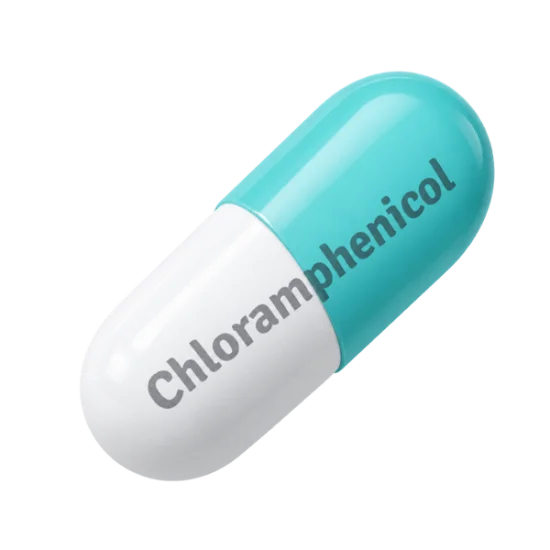
This product is presented as capsules for oral use. Chloramphenicol also exists in some markets as ophthalmic drops or ointment, yet those forms are applied to the eye and are not interchangeable with oral capsules.

Form Main route Practical characteristic
Oral capsule Swallowed Produces systemic exposure and requires medical supervision
Eye drop Applied to the eye Provides local ocular treatment with limited intended systemic exposure
Eye ointment Applied to the eye Remains on the ocular surface longer and may blur vision temporarily

Chloramphenicol eye drops and Chloramphenicol eye ointment are formulated for local eye infections such as bacterial conjunctivitis. They are not substitutes for capsules when a systemic infection is being treated. The reverse is also true: oral capsules should not be used as a replacement for a prescribed ophthalmic preparation.

The formulation changes the safety profile. Oral treatment exposes bone marrow and other organs to the active substance, while topical ocular treatment usually produces lower systemic exposure. Absorption can still occur through the eye, especially with repeated application or damaged ocular tissue.

The capsule should be swallowed whole with water. Do not open it, crush it, or mix its contents into food unless a prescriber or pharmacist has specifically approved that method for the product.

What doctors say

Doctor Perspectives

In clinical practice, physicians reserve systemic chloramphenicol for situations where the expected benefit is substantial and the treatment options are limited. A doctor usually considers the site of infection, culture results, local resistance patterns, allergies, blood counts, and organ function before prescribing it.

A prescription does not mean that every symptom should disappear immediately. Fever, pain, or fatigue may improve at different rates, and lack of improvement can indicate resistance, an incorrect diagnosis, an abscess requiring drainage, or a complication.

Doctors also look beyond the first few doses. New bruising, persistent fever, unusual pallor, or severe fatigue may matter more than mild stomach upset because they can signal haematological toxicity.

Tell the prescriber about previous abnormal blood counts, chemotherapy, seizure treatment, anticoagulants, and every antibiotic taken during the current illness. These details can change the preferred treatment.

WHO, EMA, and NICE guidance support targeted use rather than broad empirical treatment when other suitable antibiotics are available. The balance is practical: chloramphenicol can be valuable against susceptible organisms, but its safety monitoring burden limits casual use.

Comparison

Comparison table: Antibiotics

Common questions

What should happen if the expected result does not come?

A lack of improvement should prompt a clinical reassessment rather than an increased dose. EMA antimicrobial guidance issued in 2023 supports reviewing the diagnosis, culture results, bacterial susceptibility, adherence, and possible complications. The infection may be resistant, viral, incorrectly localized, or associated with a collection that requires another intervention. A clinician should reassess the treatment plan if symptoms do not improve. Seek prompt medical review if fever persists, pain worsens, confusion develops, or new symptoms appear.

Which diet, exercise, or habits help or hinder treatment?

No particular diet cures the infection or makes chloramphenicol work better. Health Canada medication-safety guidance issued in 2024 supports maintaining hydration and using regular meal habits if nausea occurs, unless the prescriber gives different instructions. Avoid strenuous exercise when fever, dizziness, weakness, or dehydration is present. Alcohol can worsen stomach upset and may obscure symptoms that should be reported.

What is the best time of day to take Chloramphenicol?

There is no universal morning or evening time because the schedule depends on the prescribed interval. WHO antibiotic-use guidance updated in 2023 favours evenly spaced doses so that antibacterial exposure remains consistent. Choose times that fit the interval and daily routine, then keep them as regular as possible. Do not move doses close together to make up for a missed capsule.

How long does a course last, and is long-term use acceptable?

The course length is determined by the infection, bacterial susceptibility, response, and clinical risk factors. EMA safety information from 2022 supports limiting systemic treatment to the shortest clinically justified duration because prolonged exposure raises concern about marrow toxicity. Long-term use is not appropriate for self-treatment or recurrent unexplained symptoms. If the infection has not improved by the expected review point, the diagnosis and treatment should be reassessed.

Which symptoms mean stopping and seeking urgent medical help?

Fever with a sore throat, mouth ulcers, unusual bruising, bleeding, severe pallor, or marked fatigue may indicate blood-cell suppression. Health Canada safety information dated 2024 treats breathing difficulty, facial swelling, widespread blistering rash, fainting, and severe weakness as urgent warning signs. Contact emergency services for airway swelling, collapse, severe breathing difficulty, or confusion. Do not take another dose while waiting for urgent medical instructions when a serious reaction is suspected.

Can older adults use Chloramphenicol?

Older adults may require closer assessment because kidney, liver, blood-cell, and medication-related risks increase with age. WHO prescribing principles from 2023 support reviewing concurrent medicines and organ function before systemic antibiotic treatment. Drugs such as warfarin, phenytoin, and other marrow-suppressing treatments can create clinically important interactions. A prescriber may arrange blood-count monitoring or select another antibiotic when the risk is too high.

Do you offer anonymous delivery?

Your order will be securely packed and shipped within 24 hours. This is exactly what your package will look like (images of an actual item sent). It has the size and look of a regular private letter (24x11x0.7 cm) and its contents cannot be seen.

Customer Feedback on Chloramphenicol

4.5
Based on 3 reviews
Ryan, 57 St. John's
Verified
Rating: 3.5 out of 5

I used the capsules for a bacterial infection and noticed improvement after several days rather than after the first dose. The treatment helped, but the schedule was inconvenient and I needed reminders to keep the timing even. I followed the prescribed dose and duration.

Nov 7, 2026
Sophie, 53 Regina
Verified
Rating: 5 out of 5

the course brought my symptoms under control and I was able to return to normal activities once the infection settled. I swallowed the capsules with water and found the routine straightforward. I followed the prescribed dose and duration.

Oct 10, 2026
Gemma, 40 Red Deer
Verified
Rating: 5 out of 5

I noticed a clear improvement during the prescribed course and finished it as instructed. The main benefit was that the fever and discomfort eased enough for me to sleep normally again. I followed the prescribed dose and duration.

Oct 22, 2026

Sources

  1. World Health Organization (2023). WHO Model List of Essential Medicines, 23rd list.
  2. European Medicines Agency (2019). Summary of Product Characteristics (SmPC) — chloramphenicol
  3. Health Canada (2019). Product Monograph — chloramphenicol
Get our free app Shop faster and track your orders 4.0 · 289 reviews Install